
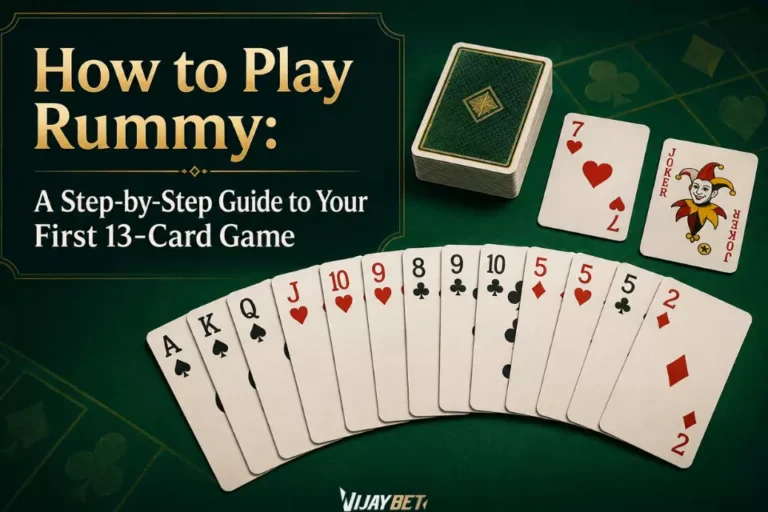
A Rummy game becomes much easier once players understand what to do with the 13 cards in front of them. The main challenge is not remembering every term at once. It is learning how to draw, discard and gradually turn an untidy hand into valid combinations.
In a standard 13-card game, the aim is to arrange every card into sequences or sets. A winning declaration must contain at least two sequences, including one pure sequence. Players work towards this goal one turn at a time while also watching which cards their opponents collect and discard.
This guide focuses on how to play Rummy from the first deal to the final declaration. It explains the table setup, each turn, card arrangement, joker decisions and the mistakes beginners should check before submitting a hand.
What Do You Need Before Starting a Rummy Game?
Before the first card is drawn, players should understand how the table is organised and what role each card may play. Identifying the decks, jokers and early combination opportunities can make the opening turns easier to manage.
Understand the table setup
Indian Rummy is commonly played by two to six players using one or more standard decks. The number of decks may depend on the number of participants and the rules used by the platform.
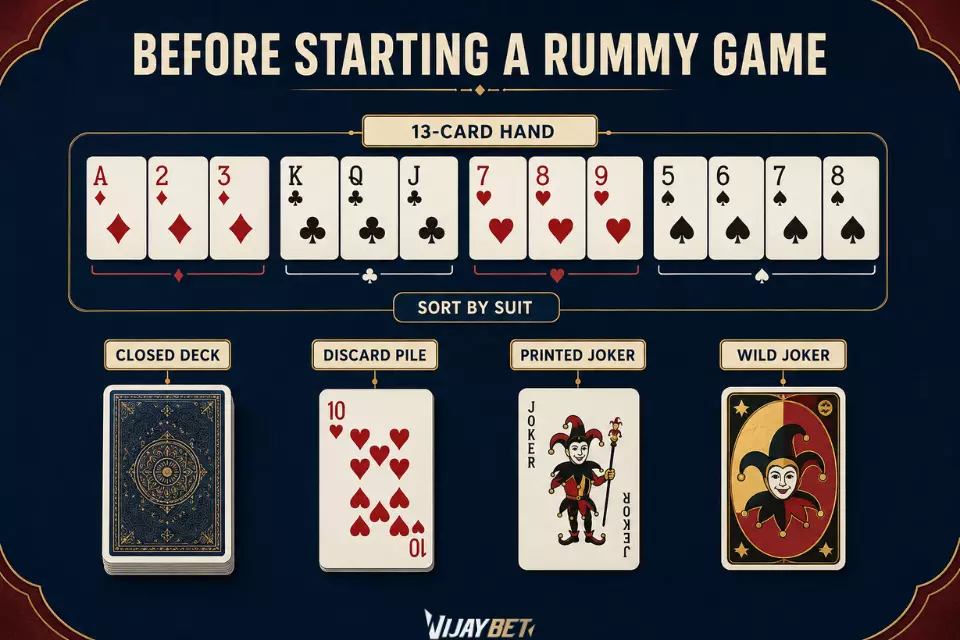
Each player receives 13 cards. The undealt cards are placed face down to form the closed deck, while one card is placed face up to begin the open deck or discard pile.
The table normally includes:
- Thirteen cards for each player
- A face-down closed deck
- A face-up discard pile
- Printed jokers
- A wild joker selected for the round
Before playing, check whether the game follows Points, Deals or Pool Rummy rules. The basic card arrangement is similar, but scoring and elimination conditions can differ.
Identify the wild joker
After the cards have been dealt, one card is usually selected as the wild joker. Every card of the same rank may then be used as a substitute in eligible combinations.
For example, if 8♦ is selected, 8♣, 8♥, 8♠ and 8♦ can function as wild jokers. Printed jokers can generally serve the same purpose.
There is one important distinction: jokers can help complete impure sequences and sets, but a substituted joker cannot create the compulsory pure sequence.
Sort the first 13 cards
Do not start by treating all 13 cards as one large group. Sort them by suit and place connected cards together.
For example:
- 4♣–5♣ may develop into a pure sequence.
- 9♥–10♥–Q♥ needs either J♥ or a joker.
- K♠–K♦ may develop into a set.
- A♣ with no nearby club cards may be an isolated high-value card.
Most digital Rummy tables include a sorting button, but players should still review the hand themselves. Automatic sorting organises suits; it does not decide which combinations are worth pursuing.
How Does Each Turn Work?
A Rummy turn follows a simple draw-and-discard pattern, but the decision between those two actions shapes the hand. Players should use each turn to reconsider their combinations instead of automatically keeping or discarding the newest card.
Draw one card
Every turn begins by drawing one card from either the closed deck or the open pile.
A card from the closed deck is unknown, but collecting it does not reveal the player’s plan. A card from the open pile is visible and may immediately complete a combination, although opponents will see that it has been taken.
Suppose a player holds 6♠ and 8♠ while 7♠ is on top of the discard pile. Picking it creates a strong sequence opportunity. In that situation, revealing some information may be worthwhile.
However, collecting a visible card simply because it matches the same suit is rarely enough. The card should create a valid combination or significantly improve the hand.
Reassess the hand
After drawing, the player temporarily holds 14 cards. This is the right moment to review every group before deciding what to discard.
A new card may change the value of the existing hand. For example, a player may originally place 9♦ with two other nines. After drawing 8♦, the card could be moved into 8♦–9♦–10♦ instead.
This flexibility matters because players cannot control which cards will appear next. Locking every card into a fixed group too early may cause better opportunities to be missed.
Discard one card
The turn ends when one unwanted card is placed into the open pile. The player should again have 13 cards.
Good discard candidates often include:
- Isolated high-value cards
- Cards that duplicate a combination without improving it
- Cards with few realistic connections
- Cards unlikely to help the current hand
Before discarding, look at the cards collected by opponents. If another player recently picked 6♥, discarding 5♥ or 7♥ could help complete their sequence.
How Should You Arrange the 13 Cards?
A valid hand is not simply a collection of useful-looking groups. It must contain at least two sequences, including one pure sequence, while the remaining cards may be arranged into additional sequences or sets.
| Combination | Basic Requirement | Can Use a Joker? | Example |
|---|---|---|---|
| Pure Sequence | Three or more consecutive cards of the same suit | No | 3♠–4♠–5♠ |
| Impure Sequence | Three or more cards forming a same-suit sequence with help from a joker | Yes | 4♣–5♣–Joker–7♣ |
| Set | Three or four cards of the same rank in different suits | Yes | 7♣–7♦–7♠ |
Complete a pure sequence first
A pure sequence contains at least three consecutive cards of the same suit without using a joker as a replacement.
Valid examples include:
- 8♦–9♦–10♦–J♦
- Q♣–K♣–A♣
- 5♥–6♥–7♥
A pure sequence is compulsory. Even if the other ten cards form valid joker-assisted groups, a declaration without a pure sequence will normally be rejected.
This is why beginners should first look for connected cards from the same suit. A pair such as 5♥–6♥ usually deserves more attention than three unrelated face cards.
Build the second sequence
A valid declaration normally requires at least two sequences. After securing the pure sequence, the second may be pure or impure.
An impure sequence follows the correct rank order and uses cards from the same suit, but includes a joker in place of a missing card. For example:
- 9♥–Joker–J♥
- Joker–Q♦–K♦
- 6♠–7♠–Joker–9♠
A joker does not remove the need for a logical sequence. Placing unrelated cards of the same suit beside a joker does not automatically create a valid combination.
Use sets for the remaining cards
A set contains three or four cards of the same rank in different suits. After completing the required sequences, sets can help organise cards that share the same rank but cannot form suitable sequences.
Examples include:
- J♣–J♦–J♥–J♠
- 5♣–5♥–Joker
- K♣–K♦–K♥
Cards with the same rank and suit should not normally be repeated in one set, even when the game uses multiple decks. For instance, two identical 7♣ cards in the same group would generally make the set invalid.
Sequences are usually more flexible than sets because a connected card may fit at either end. A pair of matching ranks, on the other hand, needs another card of that specific rank—or an eligible joker—to become a valid set.
How Should Jokers Be Used During the Game?
Jokers can make incomplete groups easier to finish, but their value depends on where and when they are used. Players should decide which combination needs the most help while keeping the pure-sequence requirement in mind.
Use jokers where they remove the most risk
Jokers are valuable because they can replace difficult missing cards. The best use is usually the combination that would otherwise be hardest to complete.
Suppose a player holds 9♣ and J♣. A joker can replace 10♣ to create an impure sequence. It may be more useful there than in a set such as 4♦–4♠–Joker, especially if another four has already appeared in the discard pile.
Players should ask a practical question: which unfinished group becomes immediately valid if the joker is added?
Do not waste a joker on a completed group
If 5♥–6♥–7♥ already forms a pure sequence, adding a joker provides no real benefit. The joker could instead complete another unfinished sequence or set.
Beginners sometimes attach jokers to their strongest groups because the combination looks safer. In practice, this reduces flexibility and leaves weaker parts of the hand unresolved.
Jokers carry zero points in common scoring systems, so there is rarely a reason to discard one unless a specific table rule creates an unusual situation.
Keep the pure-sequence rule separate
A printed or wild joker used as a substitute cannot turn an impure combination into a pure sequence.
There may be an exception when the selected wild joker appears in its natural position. For example, if 6♠ is treated as a wild joker but is used naturally in 5♠–6♠–7♠, some rules accept the combination as pure.
Because platforms may handle this situation differently, players should check the displayed rules before declaring.
When Can You Make a Valid Declaration?
Completing several groups does not necessarily mean the hand is ready to declare. Before submitting, players need to confirm that all 13 cards have been used, the sequence requirements have been met and the final discard has been made correctly.
Check the hand structure
A player should declare only when all 13 cards have been arranged correctly.
The hand generally needs:
- At least two sequences
- At least one pure sequence
- All remaining cards in valid sequences or sets
- No ungrouped cards
One possible valid hand is:
- 3♠–4♠–5♠: pure sequence
- 8♥–9♥–Joker–J♥: impure sequence
- K♣–K♦–K♠: set
- 6♣–6♦–6♥: set
Every card has a clear role, and the compulsory sequence requirements have been met.
Discard before submitting
To complete the game, the player normally draws a card, arranges the winning combinations and discards the unwanted fourteenth card. The remaining 13 cards are then submitted for verification.
The declaration button should not be pressed simply because the hand appears nearly complete. Check every suit, rank and joker position first.
A single incorrect card can turn a promising hand into a wrong declaration.
Recognise common invalid hands
A declaration may be rejected when:
- It contains only one sequence.
- Neither sequence is pure.
- A set includes repeated cards of the same suit.
- Cards in a sequence belong to different suits.
- The sequence order is incorrect.
- One or more cards remain outside the selected groups.
An incorrect declaration may result in a substantial points penalty. Taking a few seconds to check the hand is usually more valuable than trying to declare before another player.
How Should a Beginner Play the First Few Turns?
The opening turns are mainly about identifying which cards deserve to be protected and which ones create unnecessary risk. A beginner does not need a fixed plan immediately, but each draw should make the direction of the hand clearer.
Protect the strongest sequence opportunity
During the opening turns, identify the cards closest to forming a pure sequence. Connected cards such as 7♦–8♦ or 10♣–J♣–Q♣ should normally be protected.
A combination with one internal gap can also be promising. For example, 4♠–6♠ needs only 5♠, while 4♠–5♠ can be extended by either 3♠ or 6♠.
This does not mean waiting endlessly for one exact card. If several turns pass without improvement, the hand should be reassessed.
Reduce the danger from high-point cards
Aces, kings, queens and jacks are commonly worth ten points each. They are useful when connected, but expensive when left unmatched.
Holding Q♥–K♥ is reasonable because J♥ or A♥ may complete the group. Holding K♣, Q♦ and A♠ as unrelated cards creates much more risk.
Players should not discard every high card immediately. The better approach is to keep connected high cards and release isolated ones that have little chance of forming a valid combination.
Read the discard pile without depending on guesses
Visible cards give clues about what other players may be building. If someone collects 9♦, they may need nearby diamond cards or additional nines.
This information can guide safer discards, but it should not become the entire strategy. A player cannot know an opponent’s full hand, and holding too many unhelpful cards merely to block others may damage their own combinations.
The priority remains building a valid hand. Observation should support that goal rather than replace it.
Frequently Asked Questions About Playing Rummy
Sort the cards by suit, identify the best pure-sequence opportunity and separate isolated high-value cards before drawing.
No. A valid declaration requires at least two sequences, including one pure sequence. Sets alone cannot complete the hand.
No. The open pile may provide a card that immediately completes an important combination, although taking it reveals information to opponents.
Yes. Beginners can use free practice tables or virtual-chip games to learn the rules before joining real-money Rummy games on platforms such as VijayBet.
The platform may use auto-play or count the missed turn as an automatic drop. VijayBet players should check the table rules, as timeout and disconnection policies may vary by game format.
Learn How to Play Rummy One Turn at a Time
Learning how to play Rummy is mainly about creating order from incomplete information. The first goal is to secure a pure sequence, but good play also requires flexible grouping, careful discards and attention to the open pile.
A beginner does not need to predict every card. Focus on whether each draw improves the hand, whether each discard reduces risk and whether the final arrangement meets every declaration rule. With practice, these checks become quicker and the decisions made during each turn become much more confident.
👉 Want to know more about Rummy rules, card combinations and playing strategies? Follow VijayBet for more beginner-friendly guides and practical game tips.