

Pool Rummy is a multi-deal version of 13-card Indian Rummy in which players continue playing until they reach a fixed elimination score. The two most common formats are 101 Pool Rummy and 201 Pool Rummy.
Unlike Points Rummy, a Pool match is not decided after one deal. The penalty points collected in each round are added to the player’s previous score. Once the total reaches the table limit, the player is eliminated. The match continues until only one player remains.
This guide explains how Pool Rummy works, how scores are calculated and how the format differs from Points and Deals Rummy.
How Does Pool Rummy Work?
Pool Rummy follows the standard objective of a 13-card Rummy game. Each player must arrange all 13 cards into valid sequences and sets before making a declaration.
A valid declaration normally requires:
- At least two sequences
- At least one pure sequence
- All remaining cards arranged into valid sequences or sets
During each turn, a player draws one card from the closed or open deck and discards one card. The first player to arrange the entire hand correctly can submit a declaration.
What happens after each deal?
The winner of the deal receives zero points. The other players receive penalty points based on cards that remain outside valid combinations.
Unlike a single-deal game, these points are not cleared before the next round. They are added to the player’s cumulative Pool Rummy score.
For example:
| Deal | Penalty points | Cumulative score |
| Deal 1 | 18 | 18 |
| Deal 2 | 0 | 18 |
| Deal 3 | 27 | 45 |
| Deal 4 | 31 | 76 |
The player has accumulated 76 points after four deals. Whether the player is close to elimination depends on whether the table uses the 101 or 201 Pool format.
How is the final winner decided?
The match continues across multiple deals. Players who reach the stated Pool limit are eliminated, while those below the limit continue playing. The last remaining player wins the match. This cumulative structure defines Pool Rummy: players do not need to win every deal, but repeated high penalties can quickly lead to elimination.
What Is the Difference Between 101 and 201 Pool Rummy?
The main difference is the score at which a player is eliminated:
- In 101 Pool Rummy, elimination occurs when a player reaches or crosses 101 points.
- In 201 Pool Rummy, elimination occurs when a player reaches or crosses 201 points.
Both formats use the same basic card arrangement and declaration rules.
How does 101 Pool Rummy work?
Because the elimination limit is lower, 101 Pool matches generally finish sooner. A few high-scoring deals can place a player close to elimination.
Suppose a player records these results:
| Deal | Penalty points | Total score |
| Deal 1 | 24 | 24 |
| Deal 2 | 32 | 56 |
| Deal 3 | 18 | 74 |
| Deal 4 | 29 | 103 |
After the fourth deal, the player has 103 points and is eliminated from the 101 Pool match.
How does 201 Pool Rummy work?
The 201 format has a higher elimination limit, so the match may continue for more deals and players have more room to recover from an unfavourable round. For example, a player with 103 points would be eliminated from a 101 Pool table but could remain in a 201 Pool match. However, all penalties continue to accumulate.
The more suitable format depends on the preferred match length. Players looking for a shorter Pool game may choose 101 Pool, while those comfortable with a longer cumulative match may prefer 201 Pool.
How Are Points Calculated in Pool Rummy?
Scoring matters because every penalty can affect how long a player remains in the match.
Standard card values normally include:
| Card | Point value |
| Ace | 10 |
| King | 10 |
| Queen | 10 |
| Jack | 10 |
| Number cards | Face value |
| Printed Joker | 0 |
| Wild Joker | 0 |
Cards placed in valid sequences and sets do not add to the player’s penalty score. Cards that remain outside valid combinations are counted.
An example of Pool Rummy scoring
Assume a player has completed several valid combinations but is left with:
- King of Spades: 10 points
- Nine of Hearts: 9 points
- Five of Clubs: 5 points
The penalty for that deal is:
10 + 9 + 5 = 24 points
Those 24 points are then added to the player’s existing Pool score.
If the player already had 62 points, the new total would be:
62 + 24 = 86 points
The player could continue in either a 101 or 201 Pool match but would be much closer to elimination in the 101 format.
Is there a maximum penalty?
Many Indian Rummy tables limit the maximum penalty in one deal to 80 points. An incorrect declaration may also result in a high penalty.
However, scoring conditions can vary between platforms. Players should confirm the maximum penalty and invalid declaration rules displayed on the selected table.
How Do Drop and Re-entry Rules Work?
A drop occurs when a player chooses to leave a deal instead of continuing with the current hand.
Platforms may distinguish between:
- First Drop: Leaving before making the first move
- Middle Drop: Leaving after taking part in the deal
- Auto Drop: A platform-controlled option that removes the player from one or more deals
A First Drop normally carries a smaller penalty than a Middle Drop. The exact score may vary according to the platform and Pool format.
Why does a drop affect the whole match?
Drop points are added to the player’s cumulative score, and leaving one deal does not remove points collected in earlier rounds. For example, a player who already has 72 points in a 101 Pool match may move closer to elimination after taking a drop. A drop should therefore be treated as part of the overall match score, not as a way to leave the current hand without consequences.
Can an eliminated player re-enter?
Some Pool Rummy tables allow re-entry under specific conditions. A returning player may be assigned a score based on the highest active score at the table.
Re-entry is not available in every game. Conditions, charges and score adjustments can differ, so players should check the table rules before assuming they can return after elimination.
How Does Pool Rummy Differ From Points and Deals Rummy?
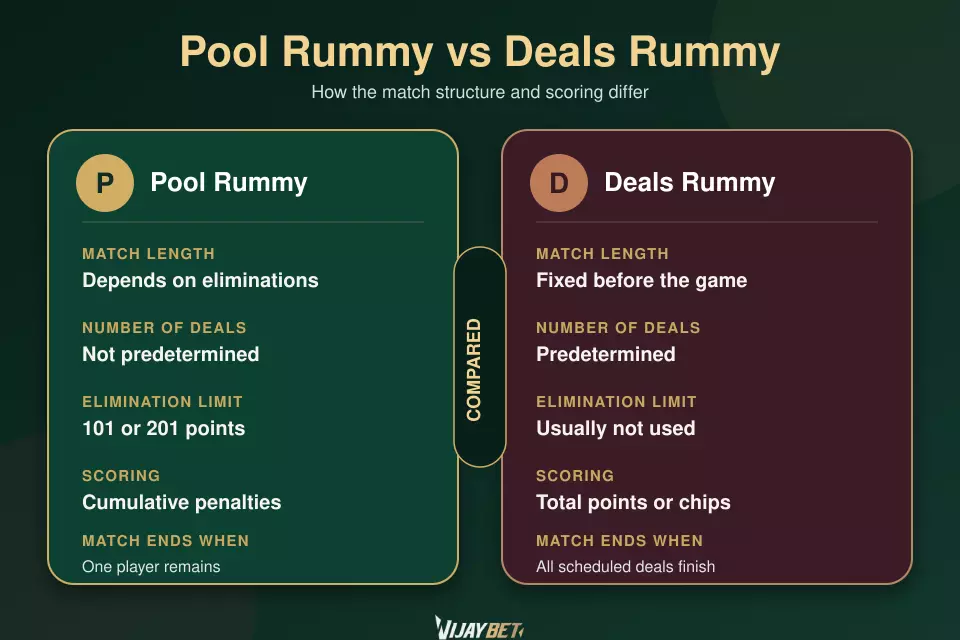
Pool, Points and Deals Rummy follow similar 13-card rules, but they determine the final result differently. Points Rummy ends after a single deal, Deals Rummy uses a fixed number of deals, and Pool Rummy continues until only one player remains below the elimination limit.
| Match structure | Multi-deal elimination match | Single-deal game | Fixed multi-deal match |
| Number of deals | Not predetermined | One | Predetermined |
| Scoring | Penalties accumulate after each deal | Calculated once | Total points or chips |
| Elimination | At 101 or 201 points | No cumulative elimination | Usually not used |
| Match length | Variable and generally longer | Shorter | More predictable |
| Winner | Last remaining player | Winner of the single deal | Best result after all deals |
Points Rummy may be easier for beginners because there is no cumulative match score to track. Deals Rummy provides a more predictable match length, while Pool Rummy requires players to follow both their current hand and their total score throughout the match.
Which Rummy Format Is More Suitable for Beginners?
Points Rummy is generally the simplest starting point because the result is decided after one deal. It allows beginners to focus on drawing, discarding and arranging cards without tracking a cumulative score.
Deals Rummy introduces a fixed series of rounds. Players know how many deals will be played and can observe how scores change across the match.
Pool Rummy may be easier to understand after the basic declaration and scoring rules are familiar. Players need to monitor both the current hand and their position relative to the 101 or 201-point limit.
A simple way to compare the formats is:
- Choose Points Rummy for a short, single-deal game.
- Choose Deals Rummy for a fixed number of rounds.
- Choose Pool Rummy for a longer elimination match based on cumulative scores.
The format does not remove the random element involved in receiving cards. Understanding the table rules and setting clear limits remain important in every version.
What Should Players Check Before Joining a Pool Rummy Table?
The name “Pool Rummy” does not mean that every platform follows identical conditions.
Before joining, check:
- Whether the table uses a 101 or 201-point limit
- First Drop and Middle Drop penalties
- Maximum penalty in one deal
- Invalid declaration penalties
- Whether re-entry is available
- How a returning player’s score is calculated
- Entry conditions and platform deductions
- Whether the game is free-play or involves money
Rules concerning real-money online games can also differ between Indian states. Players should confirm the requirements in their location and ensure that they meet the platform’s minimum age rules.
Understand Pool Rummy Before Choosing a Table
Pool Rummy turns the standard 13-card game into a multi-deal elimination match. Players continue across several rounds while their penalty points accumulate towards a limit of 101 or 201.
The format differs from Points Rummy, which ends after one deal, and Deals Rummy, which follows a predetermined number of rounds. Players who prefer a longer match with cumulative scoring may find Pool Rummy more suitable, while those looking for a shorter or more predictable format may prefer Points or Deals Rummy.
👉Ready to explore the different Rummy formats? Visit VijayBet, review the rules of each table and choose a format that matches your playing style. Play responsibly, set clear limits and never spend more than you can afford to lose.