
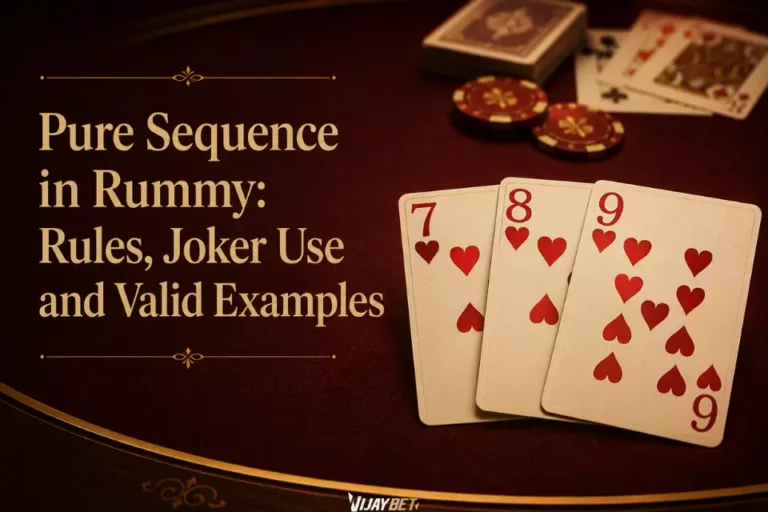
A valid declaration in Indian Rummy begins with one essential combination: a Pure Sequence in Rummy. Even if the remaining cards are arranged into valid sets or impure sequences, a hand cannot be declared successfully without at least one pure sequence.
This is why experienced players usually try to form one early. It provides the foundation for a valid hand and may also reduce the points counted if another player declares first.
What Is a Pure Sequence in Rummy?
A Pure Sequence in Rummy is a group of at least three consecutive cards belonging to the same suit, formed without using a Printed Joker or Wild Joker as a substitute.
For example:
- 5♥–6♥–7♥
- 9♣–10♣–J♣–Q♣
- A♦–2♦–3♦
In the commonly played 13-card format, a valid declaration requires at least two sequences. At least one of them must be pure. The remaining cards may be arranged into another pure sequence, an impure sequence or valid sets.
Why Is a Pure Sequence So Important?
A player cannot make a valid declaration without a pure sequence, even when every other card has been grouped correctly. For example, a hand containing one impure sequence and three valid sets is still incomplete if it does not include the compulsory pure sequence.
A completed pure sequence may also reduce the points counted if an opponent declares first, as the cards within it are no longer treated as unmatched cards. Scoring rules vary between formats and platforms, although many 13-card points rummy games cap the loss for one hand at 80 points.
Rules for Forming a Pure Sequence
A group of cards must meet four basic conditions to qualify as a pure sequence: the cards must belong to the same suit, appear in consecutive order, contain at least three cards and follow the correct use of the Ace.
Every Card Must Belong to the Same Suit
All cards in the sequence must have the same suit. Consecutive ranks from different suits cannot be combined.
- Valid: 6♠–7♠–8♠
- Invalid: 6♠–7♥–8♠
The second combination follows the correct numerical order, but the 7♥ belongs to a different suit.
The Cards Must Be Consecutive
Each card must follow the previous one without a gap in rank.
- Valid: 4♦–5♦–6♦
- Invalid: 4♦–6♦–7♦
The second combination is invalid because the 5♦ is missing.
At Least Three Cards Are Required
Two connected cards may help a player build a sequence, but they do not form a completed one. A valid pure sequence must contain at least three cards.
Longer runs are also allowed, including 3♣–4♣–5♣–6♣ and 8♥–9♥–10♥–J♥–Q♥.
An Ace Can Be High or Low
The Ace can appear before 2 as the lowest card or after King as the highest card.
- Valid low-Ace sequence: A♠–2♠–3♠
- Valid high-Ace sequence: Q♣–K♣–A♣
- Invalid sequence: K♦–A♦–2♦
The Ace cannot connect King and 2 within the same sequence. Round-the-corner combinations such as K-A-2 are not accepted under standard Indian Rummy rules.
Can a Joker Be Used in a Pure Sequence?
A Joker cannot replace a missing card in a pure sequence. When a Printed Joker or Wild Joker acts as a substitute, the combination becomes an impure sequence.
For example:
- 5♠–Printed Joker–7♠: Impure sequence
- 9♥–Wild Joker–J♥: Impure sequence
In the first example, the Printed Joker replaces 6♠. In the second, the Wild Joker replaces 10♥. Neither combination can satisfy the compulsory pure-sequence requirement.
Using a Wild Joker at Its Natural Value
One detail often confuses new players: a card selected as the Wild Joker may still be used at its original rank and suit.
Suppose 7♦ is selected as the Wild Joker for the round. The combination 6♦–7♦–8♦ may still be treated as a pure sequence because the 7♦ is being used in its natural position. It is not replacing another card.
Rules for a naturally positioned Wild Joker may vary between game providers. Players should check the table instructions before making a declaration.
Combinations That Are Not Pure Sequences
A combination may look close to a pure sequence but still fail because of a substituted Joker, mixed suits, a missing card or an invalid use of the Ace.
- 4♠–Printed Joker–6♠: Impure sequence
The Printed Joker replaces the missing 5♠. - 8♥–9♣–10♥: Invalid group
The ranks are consecutive, but the cards do not belong to the same suit. - A♦–3♦–4♦: Invalid group
The combination is incomplete because the 2♦ is missing. - K♣–A♣–2♣: Invalid group
Round-the-corner sequences are not accepted under standard Indian Rummy rules. - 7♠–8♠: Incomplete sequence
A valid sequence must contain at least three cards.
These combinations cannot fulfil the compulsory pure-sequence requirement. However, a Joker-assisted run may still be used as an impure sequence elsewhere in a valid hand.
How to Build a Pure Sequence More Efficiently
No strategy can guarantee which cards a player will receive. However, a few practical decisions can make the hand easier to organise and reduce the risk of holding too many unmatched cards.
Start With Connected Cards
Connected cards such as 7♠–8♠ are worth keeping because drawing either 6♠ or 9♠ completes the sequence. A gap pair such as 5♥–7♥ can also develop if 6♥ appears, but it has fewer completion options. When choosing between unfinished combinations, prioritise the one that can be completed by more than one card.
Keep Flexible Runs When Possible
A middle pair often provides more completion options than an edge pair. For example, 6♦–7♦ can connect with either 5♦ or 8♦, while A♣–2♣ can usually be completed only with 3♣.
This does not mean edge cards should always be discarded. The better choice depends on the rest of the hand and the cards already visible in the discard pile.
If a player already holds Q♣–K♣, keeping the pair may still make sense because drawing A♣ would complete a valid high-Ace sequence.
Be Careful With Unmatched High Cards
Aces, Kings, Queens and Jacks carry 10 points each when left unmatched. Holding several unrelated high cards while waiting for an unlikely sequence can increase the final score if another player declares.
Once a high card no longer supports a realistic sequence or set, discarding it may be safer than keeping it only because of its rank.
The decision should still be based on the full hand. A King that connects with a Queen of the same suit may be worth keeping, while an isolated King with no supporting cards creates more risk.
Watch the Discard Pile
The cards discarded by other players can show which suits or ranks may be difficult to collect.
If several cards needed for a particular run have already appeared, it may be better to reorganise the hand instead of waiting too long for one specific card. Continuing to wait for an unlikely draw can leave the hand unfinished when another player declares.
At the same time, picking a card from the open discard pile gives other players information about the combination being built. Each pickup should therefore have a clear purpose.
Complete the Pure Sequence Before Chasing Sets
Sets can be useful, but they do not replace the compulsory pure sequence. A hand containing several promising sets may still be invalid if no pure run has been completed.
Players do not need to discard every possible set immediately. The better approach is to avoid giving sets priority when the hand still lacks a realistic pure sequence.
Pure Sequence and Impure Sequence: What Is the Difference?
The main difference is how the Joker is used. A pure sequence contains consecutive cards of the same suit without a Joker replacing any missing card. An impure sequence uses a Printed Joker or Wild Joker as a substitute.
For example:
- Pure sequence: 6♥–7♥–8♥
- Impure sequence: 6♥–Joker–8♥
Both combinations can appear in a valid hand, but they do not serve the same purpose. A pure sequence satisfies the compulsory declaration requirement, while an impure sequence cannot replace it.
A Wild Joker used at its original rank and suit may still be accepted as part of a pure sequence under some game rules. Players should confirm this detail on the platform before declaring.
Common Mistakes to Avoid Before Declaring
A hand may appear complete at first glance but still contain a small arrangement error. Checking each group before pressing the declaration button can prevent an invalid declaration.
Common mistakes include:
- Treating a Joker-assisted run as a pure sequence
- Combining consecutive cards from different suits
- Using only two cards as a completed sequence
- Arranging the Ace as K-A-2
- Leaving one card outside the required sequences and sets
- Mistaking an incomplete gap sequence for a completed run
Players should also confirm that the hand contains the required number of sequences, not only one valid pure sequence. In 13-card Indian Rummy, at least two sequences are normally required for a legal declaration.
Final Thoughts
A Pure Sequence in Rummy is not simply another card combination. It is the foundation of a valid 13-card rummy declaration. The cards must belong to the same suit, follow a consecutive order and contain no Joker acting as a substitute.
The practical approach is to look for connected cards early, protect flexible combinations and avoid carrying too many unmatched high-value cards. Before playing on VijayBet or any other rummy platform, players should also review the table-specific declaration and scoring rules.
Rummy involves both skill and chance. Set a playing budget in advance, avoid chasing losses and treat the game as entertainment rather than a source of income.